Journal · Supreme Court · Ethics · Citations
Supreme Court on AI Fake Citations (2026): What Every Indian Advocate Must Change
4 Aug 2026 · Updated 30 Aug 2026 · 2 min read · Reshma Khanam
On 2 July 2026, in Pooja Ramesh Singh v. J&K Bank, the Supreme Court set aside orders that rested on invented judgments. The message was not “ban AI”. It was: citing unverified machine output is on the advocate, not the chatbot.
If you are still pasting ChatGPT case lists into a compilation, this is the week to stop.
What actually changed
- Invented authorities in a filing are now a documented Supreme Court problem, not a Twitter scare.
- The Court’s own draft rules still allow research, citation-checking, drafting help, summaries and translation — with human oversight.
- Disclosure is becoming the professional default, not a confession.
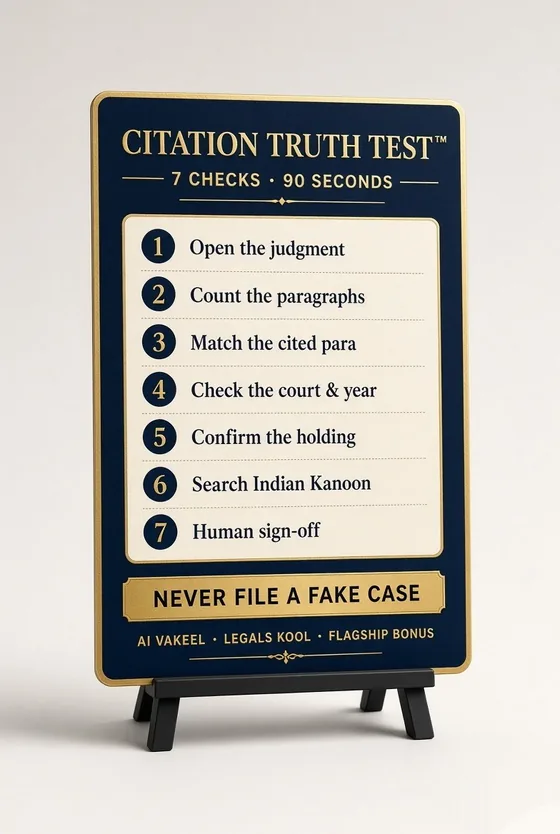
The Citation Truth Test™ — 7 checks, 90 seconds
- Exists — parties match on Indian Kanoon.
- Court and year match the document you opened.
- Citation / neutral number match.
- The quoted sentence is actually in the judgment.
- Paragraph number is inside the judgment’s length. (¶73 of a 27-paragraph judgment = fake.)
- Still good law — open “cited by”. Look for overruled / reversed / per incuriam.
- The section it applies is still in force — BNS / BNSS / BSA, not repealed IPC numbers.
All seven must pass. One fail = it does not go in the draft. Average advocates score 4/10 on a planted gauntlet. That is the skill gap AI Vakeel is built to close.
Chamber policy you can paste this week
Three lines on a card next to the intern desk: (1) no identified client data in consumer AI, (2) no citation leaves the draft until someone opened it, (3) if it is filed, it is yours. Add a one-line disclosure in the covering note when AI assisted the first cut.
AI Vakeel Day 0 and Day 2 are exactly this: red lines, Truth Test, Fake-Citation Gauntlet, plus a compliance kit. One afternoon. Then it is a habit.
Questions
Did the Supreme Court ban ChatGPT for lawyers?
No. It treated unverified AI citations as the advocate’s failure. Assistive use with verification and disclosure remains the safe path.
Do I have to disclose AI use?
Draft judicial guidance and good practice point to disclosure when AI assisted research or drafting. AI Vakeel includes wording you can adapt.